Computación
Blockchain offers promise for securing global supply chain
Noticia en inglés
Blockchain technology has the potential to transform the global supply chain and improve both the speed and security of handling the flow of goods at international borders. But researchers say big questions remain about how the transformation will unfold.
"It's an emerging technology. It's evolving," said Weidong "Larry" Shi, associate professor of computer science at the University of Houston and, with Texas A&M University engineers Yanling Chang and Eleftherios Iakovou, co-author of a paper on the subject.
The paper, published in the International Journal of Production research, explores the potential disruption and promise of blockchain to better secure the international flow of goods and identifies gaps between private industry and governmental agencies that must be addressed. The work is funded by the Borders, Trade, and Immigration Institute, a Department of Homeland Security Center of Excellence led by the University of Houston.
Shi said the work suggests that adopting blockchain to track the movement of goods globally could benefit both industry and agencies charged with ensuring the safety of cargo entering the United States. "It could move items through customs more quickly, and it would allow customs to focus its resources on the minority of cargo that needs closer scrutiny," he said.
In the paper, the researchers focused on six supply chain "pain points" - traceability, dispute resolution, cargo integrity and security, supply chain digitalization, compliance, and trust and stakeholder management - and key challenges to widespread adoption.
![[Img #57617]](https://noticiasdelaciencia.com/upload/images/10_2019/8588_215548_web.jpg)
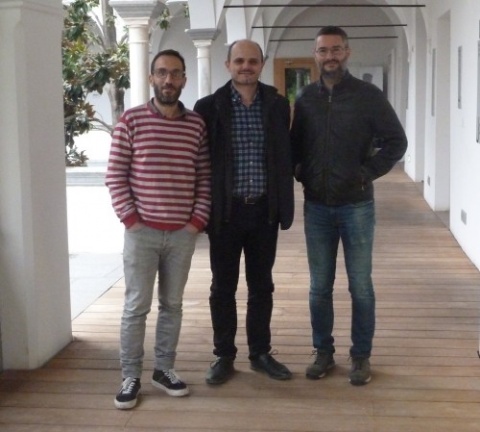
Weidong 'Larry' Shi, associate professor of computer science at the University of Houston and co-author of a paper on the obstacles facing the use of blockchain for global supply chains, says the technology could provide added security. (Credit: University of Houston)
"The wide adoption of blockchain technology in the global SC (supply chain) market is still in its infancy," they wrote. "Industry experts project that on average, it may take about six years for the widespread adoption of blockchain."
Among the challenges, Shi said, are decisions about which blockchain technology should be used - he predicts that will be determined industry-by-industry - and the need for common standards and applicable laws and regulations.
Widespread adoption will also require companies to share some data with both the governments of the countries through which the goods pass, as well as with their competitors. But the advantages could be substantial, from improving the ability to verify where goods come from and what route they traveled to reach the end user to resolving concerns about counterfeit products.
Blockchain would reduce fraud, Shi said. "The data can't be changed. Everyone (along the supply chain) has a copy. You can add information, but you can't change it."
Despite the challenges, attitudes are changing rapidly.
"Three years ago, people didn't know what blockchain was," Shi said. "They thought it was bitcoin. Now they understand that it's a technology."
The researchers are working with both industry and the federal government, and Shi said they found high interest among industry, including a few pilot projects using blockchain technology.
But any solution, he said, must incorporate the needs and duties of U.S. Customs and Border Protection in order to ensure it meets the goal of preclearing most cargo before it enters a port. "It is a better way of sharing data, and a better picture of what is going on." (Fuente: University of Houston)