Paleontología
Scientists unearth 'utterly bizarre' chimera crab fossil
Noticia en inglés
A chimera: a monster out of Greek mythology with a lion's head, a goat's body, and a snake's tail. That was what came to mind when University of Alberta paleontologists discovered a new--and bizarre--species of 90-95 million-year-old crab fossil with features of many different marine arthropods.
"We started looking at these fossils and we found they had what looked like the eyes of a larva, the mouth of a shrimp, claws of a frog crab, and the carapace of a lobster," said Javier Luque, lead author and postdoctoral paleontologist in the Department of Biological Sciences at the University of Alberta and at Yale University. "We have an idea of what a typical crab looks like--and these new fossils break all those rules."
But while the unusual crab may have features of many different families, the paleontologists found that it is actually an unusual new branch on the crustacean tree of life--not unlike a platypus of the crab world, explained Luque.
The fossilized crabs, recovered from the Andes Mountains in Colombia, once lived in a shallow coastal sea during the Cretaceous period. Researchers recovered over 70 of the specimens in soft clay, together with hundreds of other crustaceans like shrimps and lobsters.
While the fossils are no bigger than a quarter coin, Luque explains that their exceptional degree of preservation allowed researchers to pick out fine details--such as paddle legs and large eyes, suggesting the crabs spent their lives swimming, rather than crawling as most crabs do.
![[Img #55185]](https://noticiasdelaciencia.com/upload/images/04_2019/7294_199069_web.jpg)
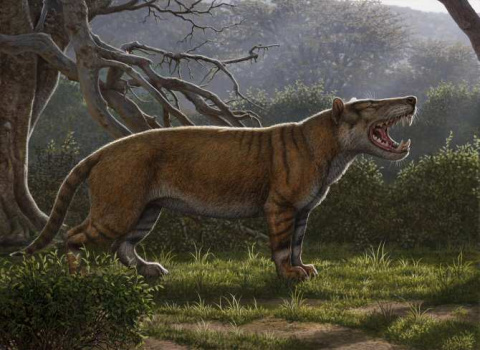
Callichimaera perplexa: the oldest swimming crab from the dinosaur era. (Credit: Daniel Ocampo R., Vencejo Films)
"We found dozens of animals, from tiny baby specimens to mature individuals in which we found reproductive organs--a smoking gun that proves these were adult organisms and not larvae. We can even see individual facets on the large compound eyes of these creatures," said Luque. "It's an incredible amount of detail, and we've been able to reconstruct them like they were living yesterday."
That incredible degree of detail has even allowed researchers to create a detailed 3D model that's 3D-printer-ready.
"It's common to find novel body forms in older rocks, for instance from the Paleozoic when life was exploding into many new forms," said Luque. "This discovery, from the mid-Cretaceous, illustrates that there are still surprising discoveries of more recent, weird organisms waiting to be found, especially in the tropics. It makes you wonder 'what else is out there for us to discover?'"
The research was conducted with support from the Natural Sciences and Engineering Research Council of Canada (NSERC), the Killam Trusts, the Smithsonian Tropical Research Institute (STRI), the Colombian Geological Survey, the Colombian Association of Petroleum Geologists & Geophysicists, and the ARES Geological Corporation.
The paper, "Exceptional preservation of mid-Cretaceous marine arthropods and the evolution of novel forms via heterochrony" was published in Science Advances. (Fuente: University of Alberta)